
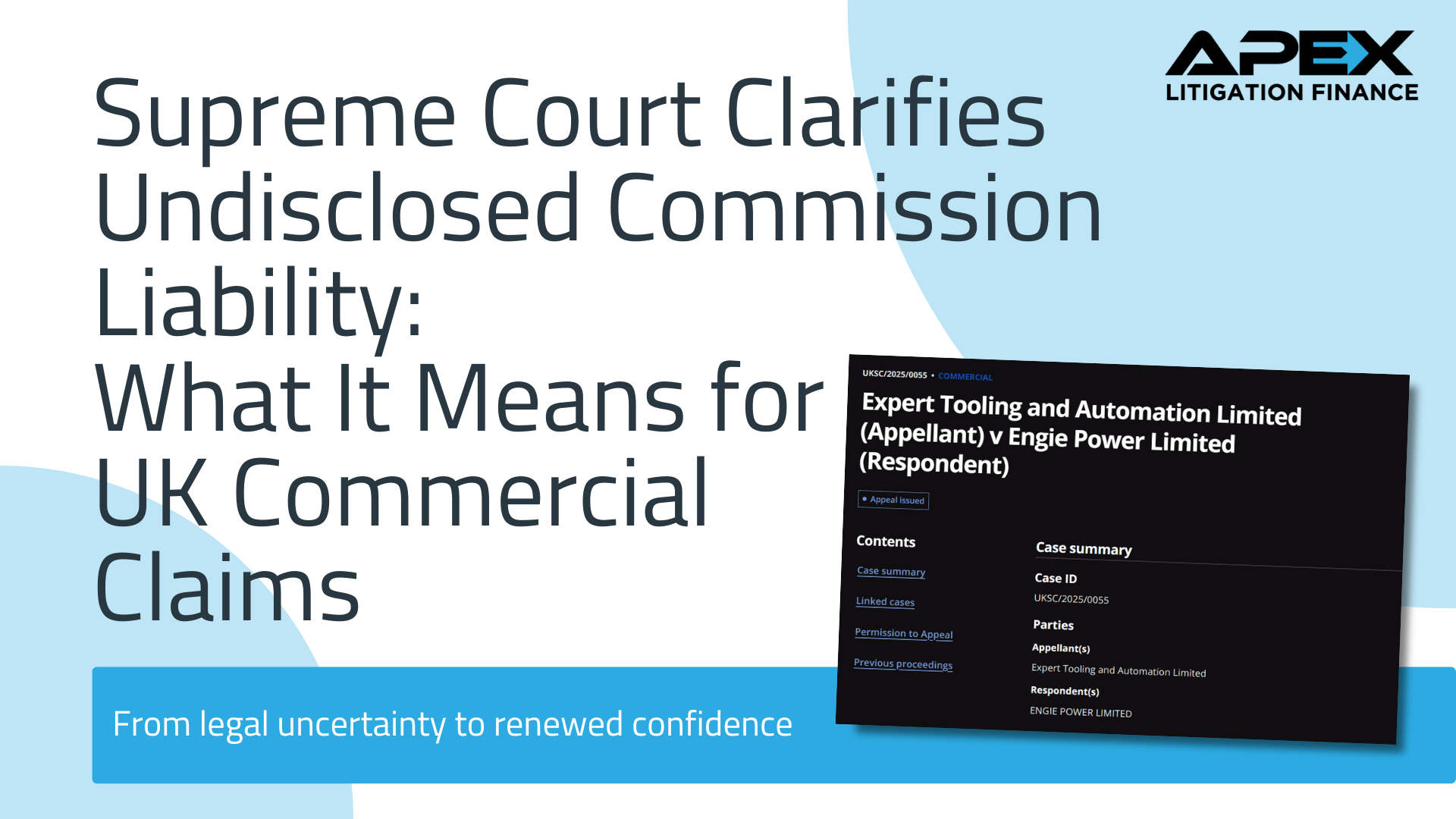
A recent decision from the Supreme Court of the United Kingdom has brought long-awaited clarity to how undisclosed and partially disclosed commissions are treated in UK commercial claims, a development that has immediate practical consequences for claim viability.
By resolving key points of principle around liability and recoverability, the Court has reduced a layer of legal uncertainty that has, until now, caused many otherwise meritorious claims to stall. For solicitors, insolvency practitioners, and corporate recovery professionals, that clarity matters because uncertainty is often the deciding factor in whether a claim proceeds at all.
In practical terms, this ruling has the effect of reopening categories of commercial claims that were previously considered too risky or unpredictable to pursue.
Undisclosed and Partially Disclosed Commissions Explained
Undisclosed commissions typically arise where an intermediary, such as a broker or agent, receives a payment from one party to a transaction that is not fully disclosed to the other.
In some cases, the existence of a commission may be mentioned, but not its amount, structure or implications. These are often referred to as “partially disclosed” or “half-secret” commissions. In legal and advisory contexts, these arrangements are often referred to as “half-secret commissions”, where limited disclosure is made but key commercial details are withheld.
The issue matters because undisclosed payments can:
- Create conflicts of interest
- Undermine trust in commercial relationships
- Distort decision-making in negotiations or procurement
From a legal perspective, the key question has long been what level of disclosure is required, and what remedies are available if that disclosure falls short. Until now, the answers were not always clear, particularly where commissions were partially, but not fully, disclosed.
That uncertainty has had real-world consequences. Advisers have had to weigh not just the underlying facts of a case, but also the unpredictability of how courts might approach liability and recovery.
What the Supreme Court Has Clarified on Undisclosed Commission Claims
The Supreme Court’s ruling provides clearer guidance on when liability can arise in cases involving undisclosed or partially disclosed commissions and when recovery may be available to the affected party.
Crucially, the decision strengthens the position that undisclosed or half-secret commissions may be recoverable where disclosure was inadequate, even if some information was shared at the time.
At a high level, the decision clarifies that:
- Liability may arise even where some disclosure has taken place
- Recovery is not dependent on navigating inconsistent or uncertain legal thresholds
- The focus is on the adequacy of disclosure and the resulting conflict, rather than technical categorization alone
While individual outcomes will always depend on the facts, this guidance significantly improves predictability. For advisers assessing risk, that predictability is critical, particularly when deciding whether a claim is worth pursuing or advising clients to proceed.
For many claims, the issue has never been the absence of wrongdoing, but whether the legal framework made enforcement commercially viable. With greater clarity now in place, the balance has shifted away from hesitation and toward reassessment.
Why the Supreme Court Decision Reopens Certain UK Commercial Claims
Legal uncertainty is one of the most common reasons commercial claims are delayed or abandoned. Even where the underlying facts are strong, uncertainty around liability or recoverability can make the risk profile difficult to justify, particularly for mid-sized claims where proportionality matters.
This is particularly relevant for claims involving brokers, introducers, procurement agents, finance intermediaries or other commercial intermediaries where commission arrangements were not fully transparent.
The Supreme Court’s clarification changes that assessment.
Where claims involving undisclosed or partially disclosed commissions were previously viewed as borderline, not because of weak facts, but because of unclear legal thresholds, there is now a firmer basis on which to proceed. Improved predictability allows advisers to assess prospects with greater confidence, model potential outcomes more accurately and advise clients accordingly.
In practical terms, this means:
- Claims that were paused pending legal clarity may now warrant reassessment
- Matters previously considered uneconomic may become viable once uncertainty is reduced
- Settlement leverage may improve, as clearer liability frameworks strengthen negotiating positions
For insolvency practitioners and recovery specialists, this is particularly relevant. Claims linked to historic transactions, intermediary arrangements, or broker-led procurement may represent assets that were previously discounted or written off. For insolvency practitioners, claims arising from undisclosed commission arrangements may represent recoverable assets that were previously discounted due to legal uncertainty. With clearer guidance now available, those claims can be reviewed through a different lens.
The key point is not that every claim will succeed, but that the decision removes a layer of unpredictability that often prevented claims from being tested at all. In a market where legal certainty directly affects whether justice is pursued, that shift is significant.
Implications of the Supreme Court Decision for Solicitors and Insolvency Practitioners
For legal and restructuring professionals, the Supreme Court’s clarification has immediate and practical implications.
For solicitors and litigation teams
Greater legal certainty makes it easier to advise clients with confidence. Where claims involving undisclosed or partially disclosed commissions were previously difficult to assess, not because of evidential weakness, but because of unsettled legal principles, advisers can now take a clearer view on prospects, remedies and proportionality.
This has knock-on effects across the lifecycle of a dispute, including:
- Early case assessment, with fewer unknowns at the liability stage
- More confident advice to clients, particularly where cost-benefit analysis is finely balanced
- Stronger settlement positioning, where clearer legal frameworks reduce scope for tactical ambiguity
In short, legal clarity supports better decision-making, both for advisers and their clients. In practice, this may prompt advisers to revisit historic matters, paused disputes or borderline claims where commission disclosure was previously assumed to be sufficient.
For insolvency practitioners and recovery specialists
The implications are equally significant for insolvency and restructuring professionals tasked with maximizing returns for creditors.
Claims connected to historic transactions, intermediary relationships or broker-driven arrangements may previously have been set aside due to uncertainty around enforceability or recoverability. With clearer guidance now in place, those matters may warrant renewed scrutiny.
For insolvent estates in particular, the ability to reassess potential claims without introducing disproportionate risk can materially affect recoveries. Where legal uncertainty has historically acted as a brake on action, clarity allows practitioners to evaluate options with greater confidence and where appropriate, take steps to pursue value.
Across both disciplines, the common theme is that certainty changes behavior. When advisers can assess claims on a clearer legal footing, more matters move from theoretical discussion to practical consideration.
The Role of Litigation Funding in Undisclosed Commission Claims
Legal clarity alone does not remove the financial and risk constraints that often sit behind commercial claims. Even where prospects improve, cost exposure, cashflow impact, and balance-sheet risk remain decisive factors. Particularly for mid-sized disputes and insolvent estates.
Where claims involve undisclosed or half-secret commissions, improved legal clarity can materially affect funding viability by reducing uncertainty around recoverability and enforcement.
This is where litigation funding plays a practical role.
With clearer guidance from the Supreme Court, funders are better able to assess claims involving undisclosed or partially disclosed commissions with greater confidence. Reduced legal uncertainty improves underwriting predictability, allowing funding decisions to be made on the merits of the claim rather than on unresolved points of principle.
For claimants and their advisers, this can mean:
- Non-recourse funding that removes downside risk
- Improved access to justice where cost would otherwise prevent action
- Greater flexibility in how claims are pursued, settled or enforced
Importantly, funding does not change the underlying merits of a claim. What it does is allow claims that are legally viable, but financially constrained — to be pursued without exposing firms or estates to disproportionate risk.
At Apex Litigation Finance, legal certainty is a critical component of responsible funding. Decisions like this one matter because they enable claims to be assessed and supported on a clearer, more predictable footing, benefiting claimants, advisers and the wider litigation ecosystem alike.
The Apex Perspective on Legal Clarity and Commercial Claims
From Apex’s perspective, legal certainty is not an abstract principle, it is a practical enabler of access to justice.
The Supreme Court’s clarification on undisclosed and partially disclosed commissions is part of a broader pattern of developments that are steadily restoring confidence across the litigation landscape. Alongside the ongoing momentum around PACCAR reform and the Civil Justice Council’s recommendations, this decision contributes to a more predictable environment in which advisers and claimants can make informed decisions.
Clarity matters because it allows meritorious claims to be assessed on their substance rather than being sidelined by uncertainty. When the legal framework is clear, claims that have sat dormant can be reviewed properly, risk can be priced realistically, and proportionate routes to recovery can be pursued.
At Apex, we work closely with solicitors, insolvency practitioners, and recovery professionals to assess whether funding can support claims that are viable in law but constrained by cost or risk. Decisions such as this one reinforce the importance of that role, enabling claims to move from consideration to action, where appropriate.
If you are reviewing a matter that may be affected by this decision, or reassessing a claim that was previously paused due to uncertainty, our team is always happy to discuss whether litigation funding could support next steps.