
Strong commercial claims increasingly fail to attract litigation funding not because they lack legal merit, but because they are not sufficiently funding-ready.
In today’s litigation market, viability, structure and commercial clarity are becoming just as important as the underlying merits of the dispute itself.
As litigation costs rise and scrutiny increases, law firms, insolvency practitioners and funders are all placing greater emphasis on how cases are presented, assessed and executed.
That shift is significant because increasingly, the question is not simply: “Can this case succeed?”
It’s: “Can this case progress efficiently, proportionately and commercially?”
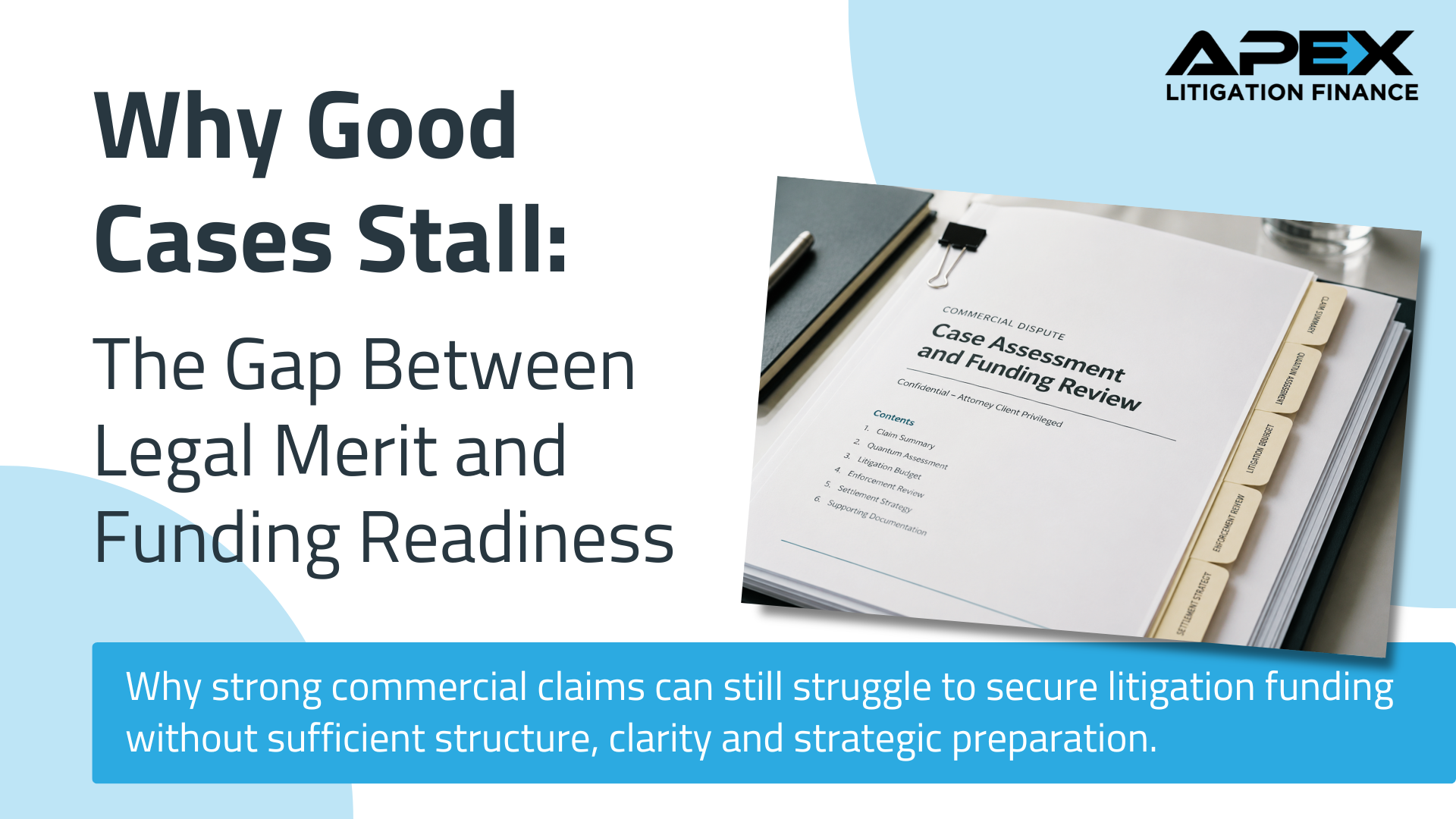
Why Commercial Litigation Is Becoming More Strategically Selective
Recent market data suggests that fewer commercial claims are being issued in the UK than in previous years. But that does not necessarily indicate a reduction in disputes.
In many cases, disputes are becoming:
- more complex
- more resource-intensive
- more strategically evaluated before proceedings are issued
At the same time:
- litigation budgets are increasing
- clients are more commercially cautious
- firms are under greater cost pressure
- scrutiny around proportionality and recoverability continues to intensify
As a result, litigation is increasingly being approached through both a legal and financial lens. That evolution is also changing how litigation funding is used.
Funding is no longer viewed solely as a last resort mechanism for cash-constrained claimants. It is becoming part of broader litigation strategy and risk management from an earlier stage in the lifecycle of disputes.
Legal Merit and Funding Readiness Are Not the Same Thing in Commercial Litigation
A strong legal claim does not automatically mean a funding-ready claim. That distinction is becoming more important across the commercial disputes market. A matter may have excellent legal merits while still presenting significant friction from a funding and execution perspective.
For example:
- key information may be fragmented
- loss calculations may remain unclear
- litigation budgets may be underdeveloped
- enforcement considerations may be uncertain
- supporting documentation may be incomplete
- the broader strategic narrative may not yet be fully formed
None of these issues necessarily undermine the underlying merits of the dispute itself.
But they can materially affect:
- due diligence efficiency
- commercial assessment
- proportionality analysis
- timing
- ultimately the viability of progressing the funding application efficiently
What Makes a Commercial Claim Funding-Ready?
The strongest funding applications are rarely the most aggressively presented. They are usually the clearest. Funding readiness is not about creating a perfectly packaged claim. It is about reducing avoidable friction and enabling efficient commercial assessment.
In practical terms, funding-ready matters often demonstrate:
- a clearly articulated case summary
- coherent supporting documentation
- realistic assessments of quantum
- proportionate litigation budgeting
- reasoned settlement strategy
- visibility around enforcement prospects
- a clear understanding of how funding supports the wider objectives of the dispute
When those elements are present, conversations become faster, clearer and more commercially productive for all parties involved.
Why Funding Readiness Improves Litigation Strategy
Funding readiness is not simply beneficial for funders.
It benefits:
- law firms seeking efficient progression
- insolvency practitioners managing estate recoveries
- claimants navigating litigation risk
- the overall execution of the dispute itself
Clearer case presentation can help reduce delays, streamline due diligence and improve the quality of strategic discussions at an earlier stage. In many situations, the process of preparing a matter for funding also helps sharpen the litigation strategy itself.
How Litigation Funding Is Shaping Commercial Dispute Strategy
The commercial disputes market is moving toward greater scrutiny, greater selectivity and greater emphasis on viability alongside legal strength. That does not make funding less accessible. But it does mean preparation increasingly matters.
At Apex Litigation Finance, we believe funding works best when it operates as part of a commercially structured litigation strategy, not simply as a reactive, or last resort, source of capital. Because in today’s market, strong claims need more than legal merit alone. They need a clear pathway to execution.
Frequently Asked Questions About Funding Readiness
What does “funding-ready” mean in commercial litigation?
A funding-ready claim is not simply a case with strong legal merits. It is a matter that is sufficiently prepared for efficient commercial assessment and progression.
This typically includes:
- clear case theory
- coherent supporting documentation
- realistic quantum assessment
- understood litigation strategy
- proportionate budgeting
- visibility around enforcement prospects
Funding readiness helps reduce friction, improve diligence efficiency and support faster strategic decision-making.
Can a legally strong case still struggle to secure litigation funding?
Yes.
Legal merit and funding readiness are not always the same thing.
A claim may have strong underlying merits while still presenting challenges around proportionality, documentation, enforcement, budgeting or commercial structure.
In many cases, delays occur not because the claim lacks strength, but because key strategic or financial elements remain unclear.
Why are funders placing greater emphasis on commercial viability?
The commercial disputes market has become more selective and commercially scrutinised.
Litigation costs have risen, disputes are becoming more complex and clients and firms are placing greater emphasis on risk management and proportionality.
As a result, litigation funding decisions increasingly consider both legal merits and broader commercial execution factors.
When should litigation funding be considered?
Litigation funding is being considered earlier in the lifecycle of disputes.
Rather than acting solely as a last resort, funding is often incorporated into wider litigation strategy, risk management and budgeting discussions from an early stage.
Early consideration can help improve planning, reduce friction and create greater commercial clarity for all parties involved.
What information helps improve funding readiness?
While every matter is different, funding discussions are often more efficient when there is:
- a concise case summary
- supporting documentation
- realistic quantum assessment
- litigation budget visibility
- understanding of enforcement considerations
- a clearly articulated strategic objective and road map for the claim
The aim is not perfection, but clarity and commercial structure.