
Litigation Funding and Access to Justice: Why Balance Matters in the UK
Access to justice depends on trust in the legal system
Access to justice is a cornerstone of the UK legal system. When individuals or businesses are wronged by far larger or better-resourced opponents, they must have a realistic way to pursue redress. For many claimants, third-party litigation funding is the only way to make that possible.
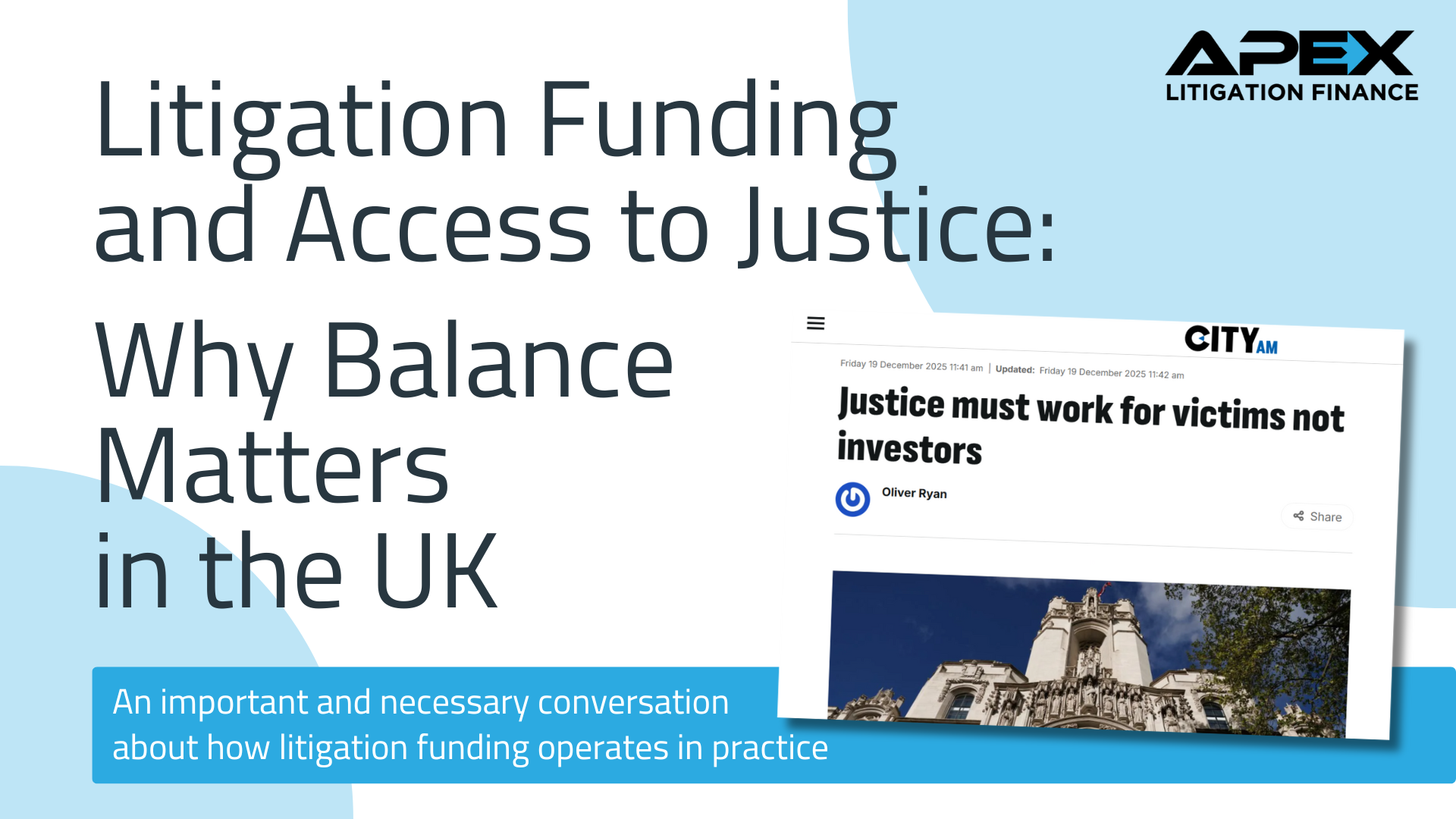
Recent commentary, including the views expressed by Oliver Ryan MP, highlights an important and necessary conversation about how litigation funding operates in practice. The concerns raised should not be dismissed. However, public confidence in the justice system matters, and any mechanism that supports access to the courts must ultimately strengthen, not undermine, that confidence.
Litigation funding primarily exists to enable justice. Where it falls short of that purpose, scrutiny is not only justified but healthy.
Litigation funding should support justice, not distort outcomes
At its best, litigation funding allows strong, meritorious claims to be pursued without exposing claimants or their advisers to unmanageable financial risk. It shares risk, levels the playing field, and helps ensure that outcomes are determined by legal merit rather than resources.
However, access to justice only works if it delivers fair outcomes for those it is intended to protect. When financial incentives become misaligned, when scale, speed or settlement pressure begin to outweigh claimant outcomes, the purpose of funding is diluted.
Claimants should never feel secondary to financial return. Funding should support legal process, not shape it. Maintaining that distinction is essential if litigation funding is to retain legitimacy and public trust.
Where concerns about litigation funding have arisen
It would be disingenuous to suggest that all parts of the litigation funding market operate in the same way, or that every outcome reflects best practice. Recent years have seen legitimate questions raised around governance, incentives and resilience in certain areas of the market.
Concerns have emerged where claims are pursued at scale without sufficient discipline, where marketing blurs the line between legal redress and lead generation, or where funding and law firm structures lack the stability required to protect claimants if things go wrong. In such circumstances, the risks are often borne by those least able to manage, accept or understand them.
Recognising these issues does not undermine the case for litigation funding. On the contrary, it reinforces the need for balance, proportion and responsibility; principles that ultimately protect claimants, advisers, investors and the justice system itself.
Why balance and proportion matter in litigation funding
Litigation funding operates at the intersection of law, finance and public confidence. When that balance is lost, the consequences extend beyond individual cases.
A system driven primarily by scale or settlement pressure risks creating instability, for claimants, for legal advisers and for the courts. Weak governance or misaligned incentives can lead to claims being pursued without sufficient merit, sudden disruption when funding arrangements unravel, or outcomes that leave those most affected feeling short-changed.
Over time, this erodes trust. Businesses face growing legal uncertainty, claimants lose confidence in the justice system, and the legitimacy of funding as a tool for access to justice is questioned. None of this serves the interests of victims, responsible funders, or the wider legal system.
Proportion matters. Litigation funding works best when it is applied selectively and thoughtfully, creating an alignment of objectives with a clear line of sight to fair outcomes.
.
What responsible litigation funding looks like in practice
Responsible litigation funding is not defined by the size or number of claims funded, but by how risk, reward and responsibility are aligned throughout the life of a case.
In practice, this means disciplined case selection, realistic economics and transparency at every stage. Claims should be assessed on merit, not marketing potential. Funding structures should be robust enough to withstand the inevitable uncertainties and detours of litigation, ensuring that claimants are not left exposed if circumstances change.
Equally important is alignment with legal advisers and clients. Funding should support strategic decision-making, not distort it. When incentives are properly aligned, funding strengthens the solicitor–client relationship and enables cases to progress on their legal merits, rather than bow to financial pressure.
These principles are not theoretical. They are essential to ensuring that litigation funding remains a trusted mechanism for access to justice rather than a source of additional risk.
Litigation funding reform and regulation as a source of stability
Ongoing debate around PACCAR and the future regulation of litigation funding reflects a broader recognition that clarity and confidence are needed across the system.
Proportionate safeguards, including transparency, capital adequacy and clear governance standards, should not be seen as barriers to access to justice. Properly designed, they provide stability for claimants and advisers alike, while reinforcing confidence in funding arrangements.
A stable, well-governed funding market supports strong claims and discourages excess. It ensures that those who rely on funding are protected, and that litigation funding continues to fulfil its original purpose: enabling justice where it might otherwise be out of reach.
Certainty and balance strengthen the system for everyone involved.
Re-centering justice and public confidence in litigation funding
Litigation funding plays an important role in the UK legal system, and it will continue to do so. For many claimants, it remains the only realistic way to pursue legitimate claims against better-resourced opponents.
But access to justice must be more than access in name alone. Outcomes matter. Confidence matters. A system that prioritises scale or financial return over fairness risks undermining the very purpose it is meant to serve.
The debate now unfolding is not about whether litigation funding should exist, but how it should operate. Balance, transparency and responsibility are not constraints on justice, they are the conditions that allow it to function properly.
If the justice system and litigation funding are to retain public trust, victims must remain at the centre of the process. Justice cannot be treated as a financial product, and access to the courts should never come at the expense of confidence in the system itself.
The Apex perspective
At Apex Litigation Finance, we believe litigation funding should enable strong claims to be pursued responsibly, with claimants’ interests firmly aligned with those providing support and capital.
We support a stable, proportionate framework that protects access to justice while reinforcing trust in the system. Disciplined case selection, transparent structures and long-term commitment are essential if funding is to serve its proper role.
Litigation funding works best when it supports justice, not when it competes with it. That principle should guide the next phase of reform.